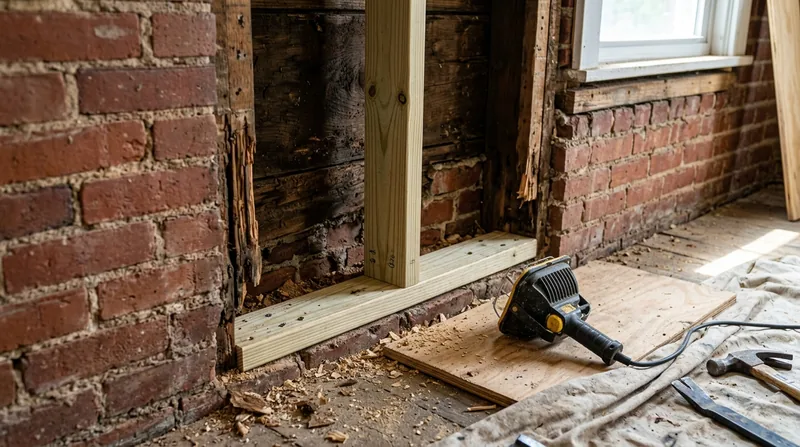




St. Louis is a brick city, built on local clay deposits and defined by its red-brick Second Empire mansions in Lafayette Square, brick two-family flats across South City, and solid brick bungalows on The Hill. Wood appears mainly in interior framing, porches, decks, trim, and window frames rather than exterior siding. The humid continental climate, hot summers, and spring thunderstorms create real termite pressure during the warm months. When termites consume structural wood, the damage stays long after the exterminator leaves. Termite damage repair means replacing the eaten studs, sill plates, subfloor sections, and trim to restore full structural integrity and prevent costly settlement or floor failure.
Why Termite Damage Repair Matters in St. Louis Homes
Termites work quietly inside framing and subfloor, often undetected until a pest inspection reveals tunneling and wood loss. By that time, studs may be hollowed, sill plates compromised, or floor joists weakened. Unlike wood rot repair, which typically follows water damage, termite damage is localized to the insects' feeding paths and often leaves sound wood nearby that can be salvaged. The humid months from May through September bring peak termite activity in St. Louis, and homes in Soulard, Benton Park, and Tower Grove with older framing are particularly vulnerable.
- We assess the extent of wood loss from your pest inspection report and determine which members can be repaired versus replaced.
- Damaged studs and sill plates are sistered or replaced in kind to maintain structural alignment and load paths.
- Subfloor sections are cut out and replaced with new material, restoring floor level and eliminating soft spots.
- Trim, casing, and exterior wood are replaced to seal the building envelope and prevent future moisture entry.
- All repairs restore the home to safe, code-compliant condition without unnecessary replacement of sound wood.
Addressing termite damage promptly prevents further settlement, floor sag, and the much higher cost of major structural repair down the road.
Key info: Termite damage in a Clayton or Webster Groves Victorian may involve hollow studs in the parlor wall and compromised sill plates at the foundation line. We work from your certified pest inspection report to identify exactly what wood needs to come out and what can stay, then restore structural integrity with new framing or sistered joists as the situation demands.
For more on structural wood pathologies, see our guide to floor joist and subfloor repair.
How We Repair Termite Damage in St. Louis: Our Process
We start with your pest inspection report, which identifies the location and extent of termite feeding. We then perform a detailed carpentry assessment to measure wood loss, identify structural members at risk, and determine which repairs can be done in place and which require member replacement. Depending on the scope, work may require a permit from the St. Louis Building Department if load-bearing members or sill plates are involved.
- We obtain and review your certified pest inspection report to locate all termite damage.
- We perform a structural assessment to measure wood loss and determine repair or replacement strategy.
- We remove damaged wood sections and prepare the area for new framing or patching.
- We install new studs, joists, sill plates, or subfloor material, sistering where structural continuity allows.
- We verify all connections are tight, load paths are continuous, and the structure is level and plumb.
- We patch, finish, and paint to match existing trim and interior surfaces.
The entire process keeps the home occupied and minimizes disruption while restoring the damaged wood to code-compliant condition.
Real example: A home in Kirkwood had termite activity in the rim joist and band board above the basement. The pest inspector flagged 18 linear feet of damage. We removed the compromised band board, installed new pressure-treated lumber, and sistered the rim joist with new framing bolted to the sill plate. The work took two days and cost less than replacing the entire rim assembly.
Learn more about how structural framing repair is approached in older St. Louis homes.
Repair Methods and When to Use Each
| Approach | Description | Best for |
|---|---|---|
| Sistering joists or studs | New member bolted alongside damaged wood to share the load and restore capacity. | Partial wood loss where structural continuity can be maintained and access allows bolting. |
| Full member replacement | Complete removal of damaged joist, stud, or sill plate and installation of new material in kind. | Extensive wood loss, hollow members, or sill plates where integrity cannot be restored by sistering. |
| Subfloor patching | Damaged subfloor sections are cut out and new plywood or boards installed over intact joists. | Surface-level termite damage above joists where structural members remain sound. |
| Trim and casing replacement | Exterior trim, window frames, or interior casing eaten by termites is removed and replaced in matching material and profile. | Cosmetic and moisture-barrier restoration where structural members are unaffected. |
| Sill plate restoration | Compromised sill plates are sistered with new pressure-treated lumber or replaced in sections as the damage pattern allows. | Termite damage at the foundation line where the sill supports the entire wall above. |
The repair method chosen depends on the extent of wood loss, the structural role of the member, and whether the damage is isolated or widespread.
Termite Damage Repair Cost in St. Louis: What to Expect
The cost of termite damage repair in St. Louis ranges widely depending on the amount of wood affected, the structural complexity, and whether permits are required. A simple repair involving a few linear feet of sill plate or rim joist sistering may start at $1,200 to $1,800. Larger jobs involving multiple studs, extensive subfloor replacement, or sill plate work across an entire basement perimeter can run $3,500 to $8,000 or more. The best way to know your actual cost is to get a detailed estimate on site after we review your pest inspection report.
Several factors influence the final price. The extent of wood loss and the number of members requiring repair or replacement are primary drivers. Access to the damaged areas, the need for temporary support during member removal, and whether the work requires a permit all add to the scope. Homes in Ladue or Creve Coeur with complex framing or heritage details may require custom sistering or matching trim that costs more than standard repair. Travel is included in our pricing across St. Louis and surrounding areas, with no separate mileage fee.
We recommend getting two or three estimates from local carpenters to compare approach and price. Be specific about what each estimate includes, whether it covers permit applications, and what warranty or guarantee is offered on the repair. See our full pricing overview for more detail on how we structure estimates and what to expect at each price tier.
Hiring a Carpentry Contractor Near Me: What to Look For in St. Louis
When you need termite damage repair near St. Louis, the contractor you choose should understand structural carpentry, know how to read a pest inspection report, and be able to explain the repair strategy in plain language. Look for a carpenter or small firm that has been in business locally for several years, carries full insurance, and can provide references from recent termite damage or structural repair work. Ask whether they handle permit applications or coordinate with the St. Louis Building Department on your behalf, especially for sill plate or load-bearing member work.
Get at least two or three detailed estimates that itemize the wood to be removed, the material and method for repair, and any finishing work included. A good estimate will reference your pest inspection report and explain why a particular repair method was chosen. Ask about the crew that will do the work, the expected timeline, and whether the contractor will be on site during key phases. If your home is in a historic district or subject to homeowners association rules, confirm that the contractor has experience navigating those requirements. Most importantly, call for a free, no-obligation estimate at (314) 338-6837 and speak directly to the carpenter who will oversee your job.
Termite Damage Repair in St. Louis: Pricing Guide
| Service | Price | Details |
|---|---|---|
| Sill plate or rim joist sistering | Starting at $1,200 | Bolting new pressure-treated lumber alongside compromised sill or rim joist, typically 10-20 linear feet |
| Stud and framing repair | Starting at $1,500 | Removal and replacement of one to three damaged studs, including temporary bracing and patching of walls |
| Subfloor patching and joist replacement | Starting at $2,000 | Removal of damaged subfloor sections and replacement, plus sistering or replacement of affected joists |
| Comprehensive termite damage repair | On estimate | Multiple members, extensive sill plate work, or complex structural changes require site assessment and custom pricing |
| Travel and estimate | Included / Free | No mileage charge across St. Louis and surrounding areas; free estimate within 24 hours, no obligation to book |
Indicative pricing, the exact cost depends on square footage, finish, and site access. Free personalized estimate within 24h at (314) 338-6837.


